
High visibility clothing according to EN ISO 20471:2013+A1:2016
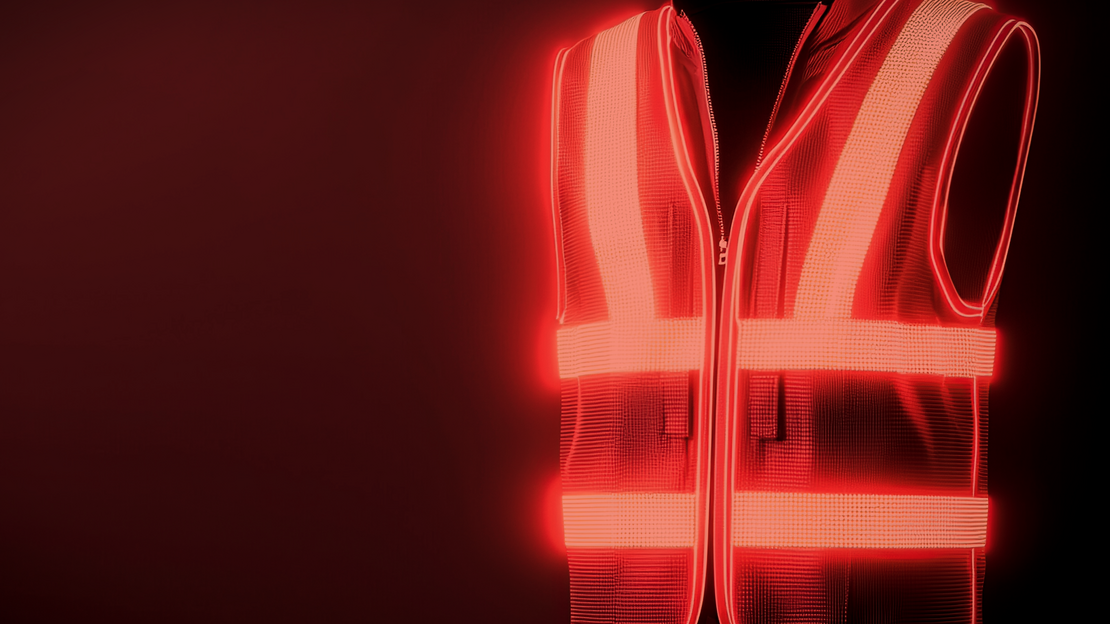
EN ISO 20471
Principle
Section 4.1 specifies the minimum required surface area of:
- Background material (fluorescent),
- Retroreflective material, and
- (Optionally) Combined performance material.
These requirements ensure that, regardless of garment design (e.g., jacket, trousers, coverall), there’s enough high-visibility material present to give 360° conspicuity.
Minimum areas depend on the garment’s classification (Classes 1, 2, or 3 — with Class 3 offering the highest visibility). E.g.:
EN ISO 20471 Classifies garments in Classes 1–3:
- Class 1: Lowest level of visibility. Suitable for low-risk environments, e.g., off-road workers.
- Class 2: Intermediate. Road works, urban construction.
- Class 3: Highest. High-speed roads, night work on highways.
The areas below are essential to achieve visibility at different distances and lighting conditions.
| Material type | Class 1 | Class 2 | Class 3 |
|---|---|---|---|
| Background material (minimal) | 0.14 m² | 0.50 m² | 0.80 m² |
| Retroreflective material (minimal) | 0.10 m² | 0.13 m² | 0.20 m² |
Test Methods
The standard references various test methods to assess:
Background material (fluorescent) color & luminance:
- Tested for colorfastness, chromaticity coordinates (CIE color space), and luminance factor after exposure to UV and washing.
- Standards: ISO 105 series (color fastness), ISO 13688.
Retroreflective performance:
- Measured by coefficient of retroreflection (Rᵃ) at specific entrance and observation angles, simulating vehicle headlights at night.
- Tested according to EN ISO 20471 Annex C, or referenced standards like EN ISO 16670.
Dimensional stability (shrinkage after washing/dry cleaning):
- Ensures garment maintains minimum required visible areas after care cycles.
Mechanical properties:
- Tear, tensile, burst resistance (ISO 13937, ISO 13934, ISO 13938), to guarantee durability.
Physiological comfort (for background fabrics):
- Water vapor resistance (ISO 11092), air permeability (ISO 9237), since discomfort can cause non-compliance in practice.

Applications
Typical garments tested & certified to this section:
- High-visibility vests, jackets, trousers, coveralls
- PPE for road workers, emergency responders, airport ground staff
- Protective clothing for rail, construction, logistics, etc.
Manufacturers must design garments to meet the minimum visible areas specified in §4.1, proven via accredited testing to comply with CE marking requirements for PPE in the EU.
Specific Testing Conditions

Specific conditions concerning our testing reports