
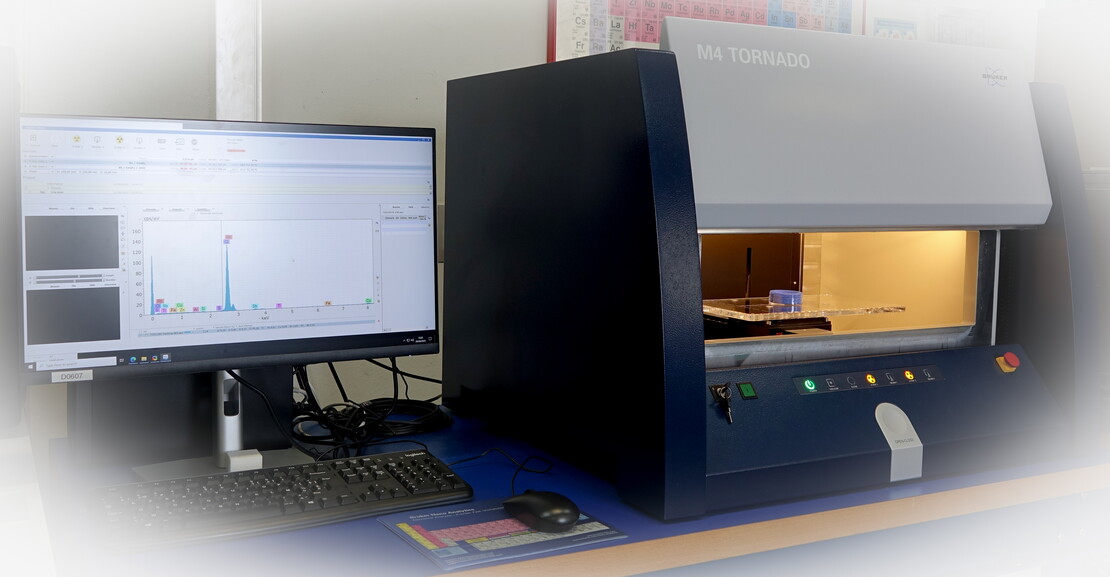
µXRF Analysis with M4 Tornado
Quality - Inspection - Customer Services & Testing
Useful Tool for Textile and Plastic Producers
Micro‑XRF analysis offers rapid, non‑destructive and highly sensitive insight into both the elemental composition and the spatial distribution of materials.
Thanks to its exceptionally fine spatial resolution- achieving spot sizes below 20 µm- the system enables precise, localized measurements, making it ideal for examining complex structures, layered coatings, printed features or small inclusions.
- MicroXRF measurements and mapping are extremely useful tools in material analysis and failure analysis.
- Determination of filler types in polymers, analysis of small inclusions, spots and other defects are some of the examples for which the micro XRF can be used. The cause of failure of certain materials is often detected by analysing a failed part with a qualitative part by XRF.
- Mapping a material and analysing the images takes more machine time but can be a very powerful tool for localisation of chemicals in a material.
- Localisation of fire retardants in a complex textile structure or localisation of fillers in polymer parts can gain very important inside information in the material.
Problem-solving
1. Solve Production and Quality Issues
When defects, discolorations, inclusions or unexpected failures occur, we help you identify the root cause quickly.
With high-resolution, non-destructive elemental mapping (spot size < 20 µm), we can:
- Identify unknown particles or inclusions in polymers
- Detect contamination in raw materials or finished products
- Determine filler types and their distribution
- Compare conforming vs. non-conforming samples
Because the analysis is non-destructive, finished goods, customer returns or high-value components can be examined without damage.
2. Improve Material Formulations
Understanding where elements are located is often just as important as knowing which elements are present.
We support R&D teams by:
- Mapping flame retardants in complex textile structures
- Evaluating dispersion of fillers in polymer compounds
- Assessing coating homogeneity
- Studying additive distribution in multilayer materials
This spatial insight allows you to optimise formulations, improve consistency and enhance performance.
3. Support Compliance and Traceability
The system detects major, minor and trace elements — including light elements (down to fluorine with adapted detector window) and heavier elements using dual-detector technology.
We can help you:
- Screen for regulated elements
- Verify supplier material consistency
- Document elemental composition for technical files
- Support customer or regulatory inquiries
Advanced quantification methods (fundamental parameters and standard-based analysis) ensure reliable, industry-ready data.
4. Enable Analysis of Real Industrial Parts
The M4 TORNADO can accommodate:
- Large or irregular components
- Samples up to 190 × 160 mm² mapping area
- Parts weighing up to 7 kg
This means we can analyse real production parts — not just small laboratory specimens.

Challenge us
We combine advanced Micro-XRF technology with expert interpretation. Our specialists translate complex spectra and maps into actionable industrial recommendations.
Whether you are troubleshooting a production issue, validating a new formulation or strengthening your quality control strategy, our Micro-XRF capability is here to support your innovation and competitiveness.