
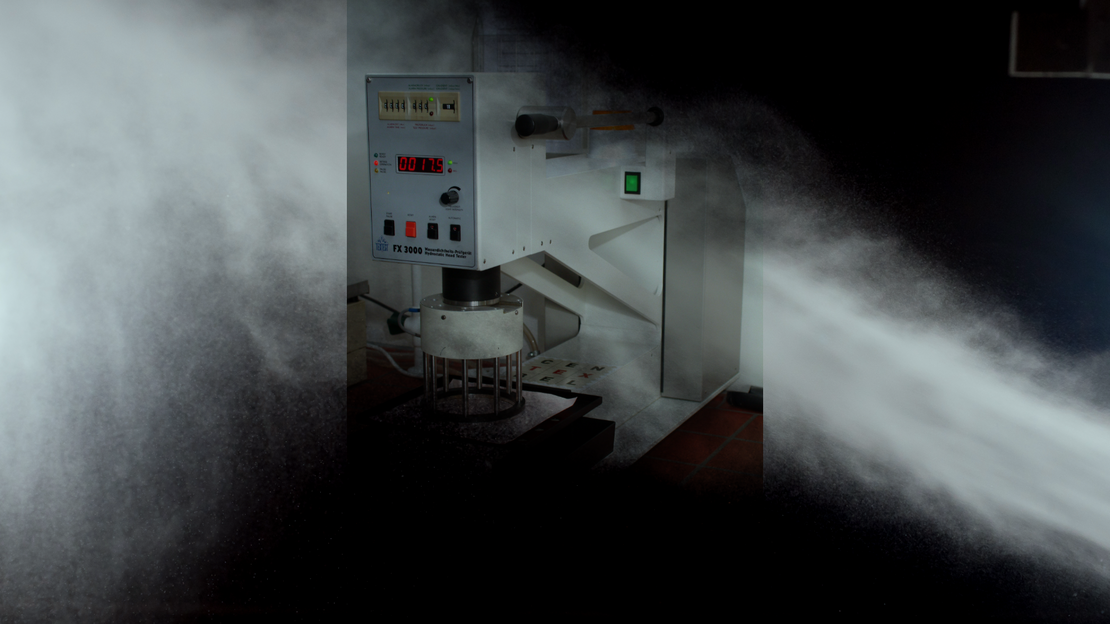
Resistance to Water Penetration: Hydrostatic Pressure Test according to AATCC 127 / ISO 811
AATCC 127
ISO 811
Principle
The hydrostatic pressure test measures the resistance of a fabric to water penetration under gradually increasing water pressure. Water pressure is applied from beneath the specimen, and the pressure at which water droplets appear on the upper surface is recorded. The test simulates conditions where fabric is exposed to standing water or heavy rain with pressure (e.g., when kneeling on wet ground or sitting on wet surfaces).
Test Method
Apparatus & Materials
- Hydrostatic head tester with a water column or diaphragm system capable of applying water pressure at a controlled rate.
- Clamping system to secure the fabric specimen.
- Pressure gauge or digital readout to record hydrostatic pressure.
Procedure
The fabric specimen is conditioned under standard atmosphere (21 ± 1 °C, 65 ± 2% relative humidity). The specimen is clamped in the tester so that water pressure is applied to the underside. Water pressure is then increased at a specified rate (e.g., 60 cm H₂O/min, or as defined in the standard).
The test ends when water droplets are observed on the fabric’s upper surface. The hydrostatic pressure at that moment is recorded, usually in cm of water (cm H₂O), kPa, or mbar. Multiple specimens are tested, and the average value is reported.
Reporting
A typical test report includes:
- Reference to AATCC 127 or ISO 811.
- Identification of the specimen (fiber composition, structure, finish or coating).
- Number of specimens tested.
- Rate of pressure increase used.
- The hydrostatic pressure result (mean, range or standard deviation).
- Any observations, such as leakage points or fabric deformation.
- Any deviations from the standard procedure.
Example report entry:
- Method: ISO 811
- Fabric: Laminated polyester, 3-layer shell fabric
- Number of specimens: 5
- Rate of increase: 60 cm H₂O/min
- Results: 12,000 mm, 12,200 mm, 11,800 mm, 12,100 mm, 11,900 mm → Mean = 12,000 mm H₂O
- Observation: No seam leakage

Main Applications
The hydrostatic pressure test is widely used to evaluate fabrics and fabric assemblies requiring high levels of waterproofness. Common applications include:
- Technical outdoor clothing: rainwear, ski wear, mountaineering gear.
- Military and protective clothing: garments requiring waterproof and breathable membranes.
- Tents and outdoor equipment: tent walls, groundsheets, awnings, sleeping bags.
- Medical textiles: surgical gowns and drapes requiring liquid barrier properties.
- Automotive and upholstery textiles: convertible tops, seat covers exposed to rain.
The method is particularly suitable for materials designed to withstand hydrostatic pressure from standing water, and complements AATCC 42 / ISO 18695, which evaluates water impact penetration.
Specific Testing Conditions

Specific conditions concerning our testing reports