
Tear resistance of coated fabrics according to ISO 4674-1:2016
Constant rate of tear methods
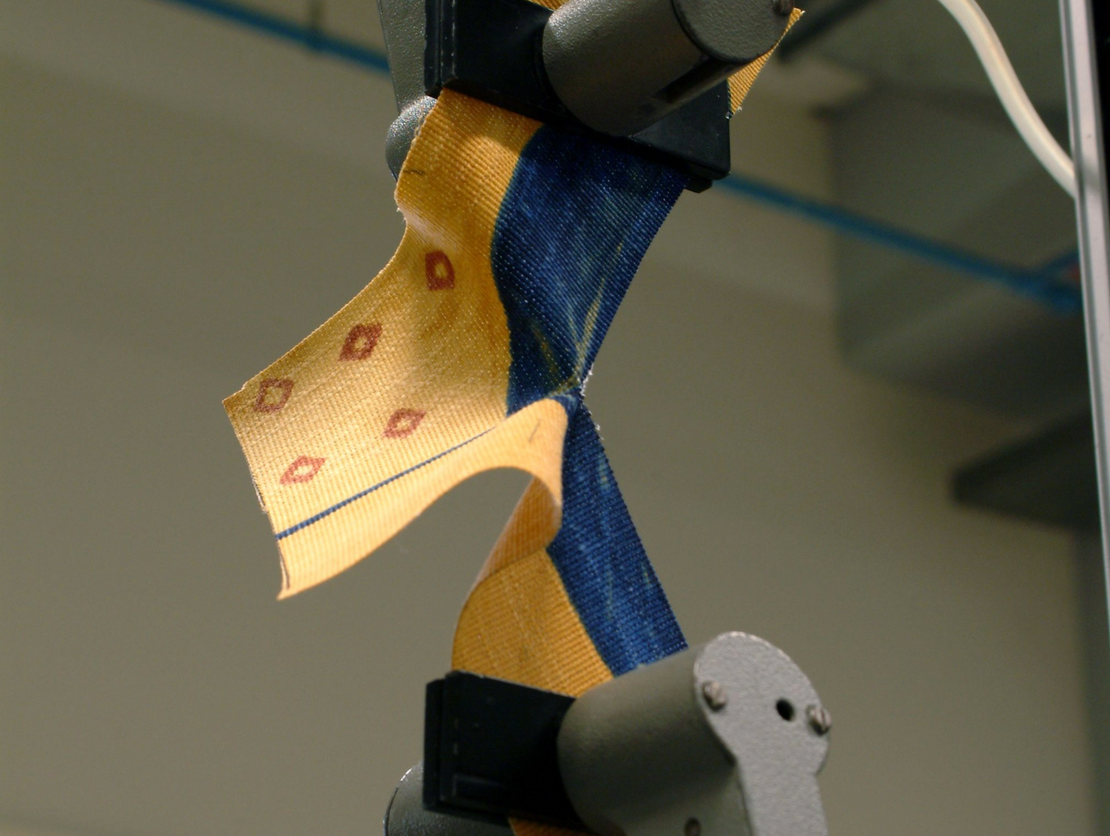
Testing lab
Physical lab
Testing standard
ISO 4674-1: 2016
Principle
EN ISO 4674-1 is a standardized test method to determine the resistance to tearing of flexible materials, such as coated fabrics, using defined test procedures. It is widely used in industries involving textiles, tarpaulins, protective clothing, and similar materials.
The standard describes two primary methods for measuring tear resistance:
Method A: The Trouser Test or Single Tear Method
- A rectangular test piece is cut with a slit partway along its length to form a "trouser" shape with two legs.
- One leg is clamped in a stationary jaw, and the other leg is pulled in the opposite direction by a moving jaw on a tensile testing machine.
- The force required to propagate the tear (i.e., to continue tearing the material from the slit) is measured.
Results
- Report the average tearing force in Newtons (N).
- Include the maximum, minimum, and standard deviation for statistical context.
Advantages
- Simulates real-world tearing scenarios.
- Useful for quality control and comparison of different material batches.
Method B: The Elmendorf Tear Test
Method B determines the force required to propagate a tear in a pre-cut specimen by measuring the energy absorbed by a falling pendulum. The material is mounted vertically, and a pendulum swings to tear the material along a precut slit. The loss of kinetic energy due to the tearing is used to calculate the tear resistance.
Results
- The tear resistance is reported in milliNewtons (mN) or milliJoules (mJ).
- Usually, results are averaged over the number of specimens tested.
- The test may be repeated with weights added to the pendulum if the tear strength exceeds the scale's capacity.
Advantages
- Quick and repeatable test.
- Widely used in quality control for thin films, paper, textiles, and coated fabrics.
- Sensitive enough for detecting small differences in tear resistance.
Comparison Between Method A and Method B
| Feature | Method A | Method B |
|---|---|---|
| Type of force measured | Tensile force (N) | Energy absorbed (mJ or mN) |
| Equipment | Tensile testing machine | Elmendorf tear tester |
| Tear propagation | Gradual, uniaxial | Instantaneous, biaxial |
| Application | Coated fabrics, textiles | Thin films, paper, lightweight fabrics |
Useful Document
Specific Testing Conditions

Specific conditions concerning our testing reports
Document